
San Francisco spans just seven miles by seven miles, yet driving across town can feel like crossing entirely different climate zones. A crisp 54°F afternoon wrapped in heavy coastal mist at Ocean Beach can quickly transform into a balmy 72°F day at Mission Dolores Park. This dramatic variation is not an anomaly—it is the everyday reality of living in a city defined by San Francisco sunbelts vs fog belts.
The Physics Behind San Francisco’s Microclimates
To understand why neighborhing streets experience completely different weather, one must look at the natural engine powering the Bay Area’s climate: thermal pressure and ocean currents. Off the California coastline, the cold California Current draws deep, icy ocean waters toward the surface. When moist air moving across the Pacific meets this cold ocean water, condensation occurs, creating the legendary marine layer locally known as Karl the Fog.
During spring and summer, inland valleys like the Central Valley heat up rapidly. As warm air rises over the interior, it creates a low-pressure vacuum that acts like a massive atmospheric vacuum cleaner. This vacuum pulls the heavy, cold marine layer off the Pacific Ocean directly through the Golden Gate gap and over the low-lying gaps in the San Francisco peninsula’s hills.
The Great Topographical Wall: Twin Peaks and the Fog Divide
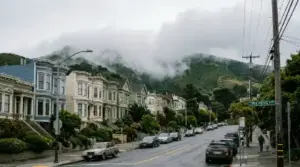
Topography is the ultimate referee in San Francisco’s climate story. The city is built across more than 40 steep hills, but none play a more decisive role than the central spine formed by Twin Peaks, Mount Sutro, and Mount Davidson. Running north-south through the center of the peninsula, this elevated ridgeline stands as a formidable barrier against incoming coastal weather.
As the marine layer rolls in from the Pacific, it collides directly with this western ridge. The high hills block and trap the low-lying cloud deck, effectively pinning cold air and moisture on the western side while leaving the eastern flank protected under clear skies.
“In San Francisco, geography is not just scenery—it dictates your wardrobe, your weekend plans, and whether you open your windows or turn on the heater.”
Living in the Fog Belt: The Cool Western Neighborhoods
Neighborhoods situated west of the central hills sit directly in the path of the Pacific marine layer. This region forms the classic Fog Belt, encompassing prominent residential areas including:
- The Outer Sunset & Outer Richmond: Directly bordering Ocean Beach, these districts experience the purest coastal weather. Summer days frequently see low clouds, cool breezes, and persistent morning fog that may not clear until late afternoon.
- West Portal & Parkmerced: Nestled southwest of Mount Davidson, these cozy residential enclaves stay cool year-round, benefitting from ocean breezes flowing through the Gap.
- Inner Sunset & Cole Valley: Sitting near the base of Mount Sutro, these neighborhoods mark the transitional zone where fog sits atop the hilltops while occasionally granting sunlit breaks.
Life in the Fog Belt develops a distinct rhythm. Residents embrace cozy indoor culture, bustling coffee shops, and durable fleece jackets. Outdoor activities are tailored around coastal conditions, and local gardens thrive with moisture-loving flora like hydrangeas, ferns, and native coastal scrub.
Basking in the Sunbelts: The Sunny Eastern District
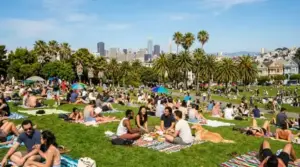
Pass through the Twin Peaks tunnel or travel east past Castro Street, and the landscape shifts dramatically. The eastern half of San Francisco sits in the rain shadow and wind break created by the central hills. This creates the coveted Sunbelts of the city, which consistently register warmer temperatures and significantly more sunshine hours per year.
Key neighborhoods within the San Francisco sunbelts include:
- The Mission District: Shielded by surrounding hills, the Mission is famously one of the warmest neighborhoods in the city. On summer weekends, Mission Dolores Park fills with thousands of residents enjoying genuine beach weather in the heart of the city.
- Potrero Hill & Dogpatch: Positioned on the southeastern slope, these historic industrial and residential hubs boast sweeping bay views and some of the highest annual sunshine totals in San Francisco.
- SOMA & South Beach: Flat terrain near the bayfront allows warm air to collect, creating comfortable microclimates for outdoor dining and urban exploration.
Detailed weather monitoring from the National Weather Service San Francisco Bay Area highlights how coastal microclimates can create temperature spreads exceeding 15 to 20 degrees Fahrenheit across short distances on summer afternoons.
How Microclimates Dictate Daily Urban Life
The stark division between sunbelts and fog belts influences far more than weather reports—it shapes daily choices, real estate dynamics, and neighborhood identity across San Francisco.
1. The Art of Layered Dressing
San Franciscans are famously devoted to layers. Crossing town for a dinner reservation or commute means preparing for multiple climate zones in a single outing. A morning commute originating in a sunny Potrero Hill apartment might end at a chilly, wind-swept office near Land’s End, making lightweight jackets, scarves, and adaptable apparel essential everyday carry items.
2. Real Estate and Sunshine Premiums
Microclimates exert a tangible effect on home values. Properties located in guaranteed sunbelts like Potrero Hill, Glen Park, and the Mission often command a premium from buyers seeking reliable sunlight and outdoor entertaining options. Conversely, buyers in the Fog Belt trade heat for larger lot sizes, ocean access, and quieter residential streets.
3. Neighborhood Culture and Social Gathering
Urban life adapts to sunlight. Sunbelt neighborhoods feature vibrant sidewalk dining, outdoor beer gardens, and packed public parks throughout the warmer months. In fog-belt communities, public social life revolves around warm cafes, neighborhood bookstores, cozy taverns, and vibrant indoor gathering spaces.
Embracing San Francisco’s Microclimatic Diversity
San Francisco’s geography ensures that no single weather forecast can ever capture the full story of the city. Whether you seek the moody, atmospheric romanticism of the coastal fog belts or the radiant warmth of the eastern sunbelts, the city’s complex terrain offers a climate for every preference—often just a short walk away.