
The Native Landscape and Early European Encounters

Long before ships filled the bay and wooden shacks lined the hills, the San Francisco Peninsula was the ancestral homeland of the Ramaytush Ohlone people. For thousands of years, the Ramaytush Ohlone managed the land, relying on its abundant natural resources. They harvested shellfish along the tide pools, gathered acorns from native oaks, and navigated the bay using crafted tule reed canoes. The region’s landscape was defined by shifting sand dunes, oak woodlands, and dramatic coastal bluffs carved out by thousands of years of Pacific ocean winds.
European contact began in earnest during the late 18th century. In 1769, a Spanish overland expedition led by Gaspar de Portolá sighted San Francisco Bay. Recognizing the strategic military and navigational value of the deepwater harbor, the Spanish established the Presidio of San Francisco in 1776, alongside Mission San Francisco de Asís (popularly known as Mission Dolores). You can learn more about the preservation of these original military boundaries through the National Park Service Presidio of San Francisco archives.
During this era, European influence remained modest, concentrated around mission farmland and military outposts. Following Mexico’s independence from Spain in 1821, the territory came under Mexican rule, and a small trading village named Yerba Buena was established near the cove that would later become the city’s downtown financial center.
1848–1855: The Gold Rush and the Explosive Boomtown
In January 1848, James W. Marshall discovered gold at Sutter’s Mill in the Sierra Nevada foothills. The news quickly spread across the globe, setting off one of the largest mass human migrations in modern history. Almost overnight, the quiet settlement of Yerba Buena—renamed San Francisco in 1847—was transformed into a roaring, chaotic boomtown.
In 1848, the population of San Francisco was roughly 1,000 residents. By 1850, that number had surged to over 25,000 as fortune seekers, known as “Forty-Niners,” poured in from South America, Europe, China, Australia, and the eastern United States. Hundreds of abandoned sailing ships choked the harbor as entire crews deserted their vessels to trek to the goldfields. Lacking lumber and formal infrastructure, early residents converted these abandoned hulls into warehouses, hotels, and saloons, eventually filling in the mudflats around them to create new land along the waterfront.
This rapid expansion created an extraordinarily diverse, cosmopolitan, and lawless environment. To research original primary documents and historical photography from this era, explore the collections maintained by the California Historical Society. The Gold Rush established San Francisco as the economic engine of the American West, establishing banking institutions, commercial shipping lines, and a reputation for bold reinvention.
Industrialization, Cable Cars, and the Gilded Age
As the initial gold frenzy stabilized into organized mining operations, San Francisco evolved from a tent city into a wealthy, sophisticated Victorian city. The discovery of the Comstock Lode silver deposit in Nevada during the 1850s poured fresh capital directly into San Francisco’s financial district, funding opulent hotels, grand mansions on Nob Hill, and civic cultural institutions.
The city’s famously challenging geography—defined by 43 distinct hills—presented severe transit challenges. In response, Andrew Smith Hallidie tested the world’s first cable car system on Clay Street in 1873. This technological breakthrough allowed urban growth to expand upward onto steep inclines previously inaccessible to horse-drawn carriages, opening neighborhoods like Nob Hill, Russian Hill, and Pacific Heights to residential development.
Simultaneously, distinct cultural enclaves flourished. San Francisco’s Chinatown grew into the largest and oldest Chinese community in North America, serving as a social and economic anchor for immigrants who helped build the Transcontinental Railroad and regional agriculture.
The 1906 Earthquake and Great Fire: Destruction and Rebirth
On the morning of April 18, 1906, a violent magnitude 7.9 earthquake struck the San Francisco peninsula. While the initial ground shaking caused immense damage, it was the subsequent fires—fueled by ruptured gas lines and exacerbated by broken water mains—that devastated the city. The great fire raged for three days, destroying over 28,000 buildings across 500 city blocks.
More than half of the city’s population was left homeless, forcing tens of thousands into tent camps established in Golden Gate Park and the Presidio. Detailed photographic records and eye-witness accounts of the disaster are available via the Library of Congress San Francisco Earthquake Records.
Despite the immense devastation, San Francisco’s civic leaders and residents mobilized quickly. Rather than abandoning the site, city planners rebuilt with extraordinary speed, replacing wooden structures with steel-framed, fire-resistant architecture. Just nine years later, San Francisco hosted the 1915 Panama-Pacific International Exposition, celebrating both the opening of the Panama Canal and the city’s triumphant rebirth on the world stage.
Becoming a Pacific Gateway: Engineering and Modern Identity
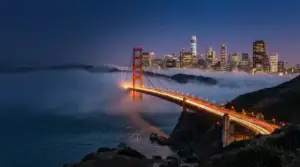
The mid-20th century transformed San Francisco from a regional hub into a critical Pacific gateway. The completion of two engineering marvels in the late 1930s—the San Francisco–Oakland Bay Bridge and the Golden Gate Bridge—physically linked the city peninsula to the wider Bay Area region, accelerating suburban growth and trade mobility.
During World War II, San Francisco served as the primary port of embarkation for the Pacific Theater. Thousands of military personnel, defense workers, and industrial laborers streamed into the area, reshaping the demographics of neighborhoods like the Western Addition and Hunters Point. In 1945, delegates from around the world met in the city to draft and sign the United Nations Charter, cementing San Francisco’s standing in international diplomacy.
The post-war era brought cultural revolutions. The Beat Generation of the 1950s made North Beach a literary refuge, while the 1967 “Summer of Love” in the Haight-Ashbury neighborhood established the city as an international capital of counterculture and social movements. By the late 20th century, the rise of nearby Silicon Valley drew wave after wave of technological innovation, transforming the historic industrial waterfront into a high-tech modern metropolis.
Conclusion: Understanding San Francisco Today
From an isolated coastal mission outpost to a bustling Gold Rush boomtown, and finally to a premier Pacific metropolis, San Francisco’s evolution is written directly into its urban landscape. Its steep hills, historic Victorian streetscapes, historic maritime waterfront, and modern glass towers reflect a rich heritage of resilience and rapid adaptation. Exploring San Francisco today means walking through centuries of living history—where every neighborhood tells a unique story of geographical challenge and cultural transformation.