
Early Maritime Navigation and The First West Coast Lighthouse

To the indigenous Ohlone people who inhabited the surrounding coastal shores for thousands of years, the rocky outcrop was largely avoided due to its barren terrain, lack of fresh water, and isolation. In 1775, Spanish explorer Juan Manuel de Ayala mapped the bay and named the arid landmass La Isla de los Alcatraces (The Island of the Pelicans), referencing the vast colonies of seabirds roosting along its steep cliffs.
When Northern California was ceded to the United States following the Mexican-American War, the strategic importance of San Francisco Bay skyrocketed overnight. The discovery of gold in 1848 brought hundreds of sailing vessels into the bay, creating an urgent need for navigational aids through the treacherous Golden Gate entry.
In response, the U.S. government authorized construction of the West Coast’s very first operational lighthouse on the summit of Alcatraz in 1853. Standing guard over the dark, fog-choked harbor, the original 86-foot brick tower illuminated the narrow shipping lanes until it was damaged during the Great Earthquake of 1906, after which it was replaced by the imposing 84-foot concrete lighthouse structure that still stands today.
The 19th-Century Military Fortress: Citadel of the Pacific
As maritime traffic expanded, President Millard Fillmore issued an executive order in 1850 reserving the island for military defense. Recognizing that controlling Alcatraz meant controlling access to the vast wealth flowing out of San Francisco’s ports, the U.S. Army Corps of Engineers set about transforming the natural rock into a formidable military fortress.
Engineers excavated the steep sandstone slopes, replacing natural rock faces with towering brick masonry walls, iron guard gates, and fortified gun batteries. By the dawn of the American Civil War in 1861, Fort Alcatraz was equipped with more than 100 heavy artillery cannons, making it the most heavily fortified military garrison on the West Coast. Alongside Fort Point and the Presidio, Alcatraz formed a defensive triangle designed to repel potential foreign navy blockades or Confederate raids aiming to capture California’s vast gold reserves.
Because the island was completely surrounded by deep, swift currents hovering near 50°F, military commanders quickly realized its natural suitability for holding prisoners. During the Civil War, the fort served as a military prison for Confederate sympathizers, privateers, and military deserters. In subsequent decades, the military facilities expanded to incarcerate Native American leaders who resisted federal allotment policies, including Hopi men imprisoned in 1895 for defending their traditional land rights.
1934–1963: America’s Ultimate Maximum-Security Federal Penitentiary
By the early 20th century, the U.S. Army determined that the aging brick citadel was obsolete for modern warfare. In 1909, soldiers demolished the historic brick fortress, leaving its massive underground cellars to serve as the foundation for a gigantic, reinforced-concrete cellhouse. Completed in 1912, the building was designated the Pacific Branch of the U.S. Disciplinary Barracks.
The turning point in Alcatraz’s public legacy arrived during the Great Depression. The 1930s saw a massive surge in violent organized crime, bank robberies, and gangland violence across the United States. In 1933, the Department of Justice acquired the island, converting the military barracks into a state-of-the-art federal penitentiary designed specifically to hold criminals who were considered too dangerous or uncontrollable for standard federal prisons.
Opening its doors as a Department of Justice facility in August 1934, Alcatraz operates under a strict, unforgiving philosophy: minimum privileges, maximum security, and absolute isolation. Inmates were provided four basic rights: food, clothing, shelter, and medical care. Everything else—family visits, access to the library, outdoor recreation, and work detail—had to be earned through strict obedience.
During its 29 years as a federal penitentiary, Alcatraz housed a total of 1,576 prisoners. Notable inmates included notorious Chicago mobster Al Capone, kidnapper George “Machine Gun” Kelly, and Robert Stroud, known as the “Birdman of Alcatraz.” The prison maintained a 1-to-3 guard-to-inmate ratio, far higher than any contemporary correctional facility.
Despite 14 distinct escape attempts involving 36 prisoners over the decades, federal officials maintained that no inmate ever successfully escaped from “The Rock.” The most famous break occurred in June 1962, when Frank Morris and brothers John and Clarence Anglin meticulously crafted dummy heads out of papier-mâché and soap, chipped through deteriorating concrete cell vents, and slipped into the icy bay on a crude raft made of raincoats. Their ultimate fate remains one of America’s most famous unsolved mysteries.
The 1969–1971 Native American Occupation: A Turning Point for Civil Rights
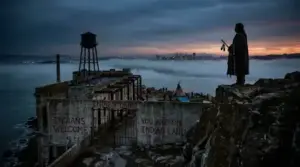 In March 1963, Attorney General Robert F. Kennedy officially ordered the closure of Alcatraz Penitentiary. The extreme cost of operating an island facility—where all fresh water, food, fuel, and supplies had to be shipped in daily—coupled with the severe saltwater corrosion of its concrete walls made long-term maintenance unsustainable.
Left abandoned for several years, the island became the catalyst for a monumental chapter in modern American civil rights history. In November 1969, a collective of Native American activists calling themselves “Indians of All Tribes” landed on Alcatraz and claimed the island by right of discovery under the Treaty of Fort Laramie of 1868, which granted surplus federal land back to Native peoples.
Led by Richard Oakes and other college students, the occupation lasted 19 months, drawing international news coverage to the systemic injustice, poverty, and broken treaties faced by Indigenous communities. While the U.S. government forcibly removed the final occupiers in June 1971, the movement permanently shifted federal Indian policy away from forced termination and toward tribal self-determination and cultural preservation.
Conclusion: From Forbidden Rock to Historic Treasure
In 1972, Congress integrated Alcatraz Island into the newly created Golden Gate National Recreation Area. Today, managed by the National Park Service, the island welcomes over 1.4 million visitors each year. Beyond its crumbling prison cells and historic lighthouse, Alcatraz has also returned to its natural roots, serving as a protected sanctuary for thousands of nesting seabirds.
To explore Alcatraz Island history is to examine the evolving values of the American nation—from military dominance and industrial incarceration to civil rights activism and ecological stewardship. Standing high above the foggy bay waters, “The Rock” remains an enduring testament to human resilience, justice, and historic transformation.